Showing 1-16 of 16 results
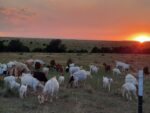
Reducing Predation in Multi-Species Grazing
New Mexico rancher Sydney Franz tested two approaches to kidding goats for economics and safety and found a clear winner. Sydney Franz moved her goat ranch, K&C Boer Goats, from central Texas to Mora County, N.M. to partner with Turner Ranches. Their dream was to establish multi-species grazing for land restoration and improved profitability. “In […]
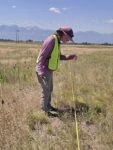
Learning How Bison Grazing Impacts Rangelands and Invasive Grasses
The 19,000-acre Bison Range on the Flathead Indian Reservation is the traditional homeland of the Confederated Salish and Kootenai Tribes. Here, the Salish, Kootenai, and Pend d’Oreilles tribes have focused on land restoration, soil health improvement, and invasive species containment in response to climate change. Invasive annual grasses, particularly Ventenata dubia, pose significant threats to […]
Virtual Fence User Guide
The virtual fence webpage on Rangelands Gateway allows potential users to access resources, tools, workshop materials, webinar information, and multimedia resources. Virtual fencing (VF) has the potential to change grazing systems by allowing unprecedented impact over livestock distribution. The systems use invisible barriers, established by GPS coordinates, to influence livestock movement with a combination of […]
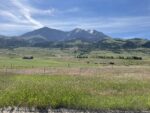
A New Tool for Managing Invasive Grasses in Montana
Invasive annual grasses, such as cheatgrass and ventenata, are reducing the abundance of native grasses that livestock producers depend on in the semi-arid rangelands of southwestern Montana. At the current low-to-moderate levels of invasion, it’s crucial to begin targeted management before invasive populations become too advanced. To guide efforts to slow or halt annual grass […]
Impacts of Compost Application on the Drought Resiliency of Rangeland
Severe droughts, expected to increase due to climate change, pose threats to California’s rangelands. Ranchers and rangeland managers are facing decreased livestock forage production, reduced biodiversity, and soil degradation. A previously funded Western SARE project (grant number OW19-349) found that compost amendments provide benefits to soils and forage productivity, including greater resilience to drought. However, […]
Targeted Grazing
Wildfires throughout the West are growing more severe. Fire season starts earlier, lasts longer and claims more lives and property along the way. Grazing is one of the most effective, cost-efficient tools available to lessen fire spread and severity. And now, thanks to a recent Western SARE-supported project, grazing has become even more useful to […]

Biofertilizers in High Elevation Meadows
Livestock producers in the high elevation areas of Wyoming and Colorado depend on hay meadows for their forage production. Because of limited precipitation and low fertility, producers have routinely practiced flood irrigation in these meadows and apply high rates of nitrogen fertilizer to guarantee sufficient production. Yet, these integral meadows are underperforming, expensive to manage, […]
Exploring Montana Agriculture
The SARE Fellows trip to Montana was amazing. I enjoyed seeing the collaborative efforts among the various farms and organizations to share their knowledge, expertise, and resources to help each other thrive while meeting the needs of the community. This experience has shown me how people working together is what truly makes programs sustainable. – […]
Cheatgrass-Eating Sheep
Wildfires in the West are inevitable and part of a natural, necessary ecological cycle, but invasive grasses like cheatgrass can make fires burn hotter, spread farther and cause more destruction. So, across the West, researchers, range managers, cattle ranchers and others are looking for ways to economically control cheatgrass and other invasive grasses on millions […]
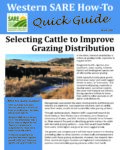
WSARE Quick Guide: Selecting Cattle to Improve Grazing Distribution
Quick guide summarizing what you can do to select cattle to improve grazing distribution.
On-Farm Internship Training Binder
The Placer Ag Futures Project was conceived as a response to critical issues affecting local agricultural sustainability. This project was intended to help grow a new crop of agricultural professionals that are trained in sustainable agricultural practices. One part of the Ag Futures Project was the on-farm internship training. The summer internship program consisted of […]
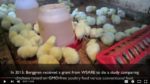
Market Opportunities of Conventional vs. GMO-free Broilers
Berggren Demonstration Farm (now Phoenix Farm Enterprises, Inc) performed a side-by-side comparison of pasture-raised Cornish Cross broilers fed on GMO-free feed vs. conventional feed. Three batches of birds were raised under experimental conditions, tracking feed costs, labor inputs, transportation, and dressed weight at processing. At point of sale, consumers were informally surveyed to evaluate preferences […]
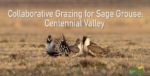
Collaborative Grazing for Sage-Grouse: Centennial Valley
This video portrays the Collaborative Grazing for Sage-Grouse Project in the Centennial Valley focusing on understanding how grazing management affects sage-grouse survival. Better understanding will be important to increasing sage-grouse populations.
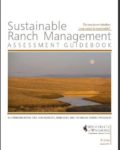
Sustainable Ranch Management Assessment Guidebook
The purpose of the guidebook is to assist the rancher and/or land manager use business planning and ecological monitoring to ensure the ranch or land is managed in a sustainable manner.
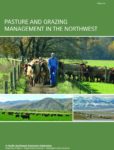
Pasture and Grazing Management in the Pacific Northwest
A book that provides knowledge of ecological processes involved in pasture growth and utilization and an understanding of how management influence those processes for good or bad.
Fresh Growth Podcast
Fresh Growth: Approaches to a More Sustainable Future from Western Ag Practitioners introduces you to farmers and ranchers from around the western United States who are finding innovative sustainable practices that enrich the natural resources we all care about. These successful multi-generational operations experiment with new ideas and are making it pay. Listen in as they tell their story and provide advice for young or beginning farmers.Western SARE, funded by USDA NIFA, provides grants and education to advance innovations in sustainable agriculture. Intro music credit: Organic Energy by Kensington Studios used under license from Shutterstock. Learn more about Western SARE at western.sare.org