Showing 1-13 of 13 results
Cut Flower Production Fact Sheets
Cut flowers represent a fast-evolving market with lucrative opportunities for producers. However, cut flowers require a high level of expertise to produce and are challenging to grow especially in Utah’s high-elevation and arid to semi-arid climate. These fact sheets are designed to support cut flower growers in Utah.

Can Introducing Mason Bees Boost Berry Pollination?
When it comes to berry pollination throughout the West, honeybees are the biggest show in town. That can be a problem for pollination diversity and for farmers because honeybees aren’t always the best option for some crops. “That’s especially true with blueberries,” said Miranda Jones, a graduate student in biology at Utah State University. “Blueberries […]

The Terroir of Bison
Is Grass-Fed Bison Better for your Health? Not all bison burgers are created equal. As with other livestock, it stands to reason that how and where bison are raised would impact the meat’s nutritional profile. But there isn’t much science on how different forages and finishing strategies effect bison quality. Until now. Nutrition science […]
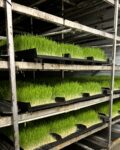
Grow Your Own: Testing the Benefits and Economics of Feeding Sprouted Grains
A few wet winters haven’t dimmed memories of the severe drought Utah cattle producers – and producers around the West – lived through over several years. “A whole bunch of producers had to downsize their herds because there wasn’t pasture for their cattle and hay was so expensive,” said Kara Thornton-Kurth, an associate professor in […]
Promoting Water Recycling in Nurseries
One way to use water more efficiently is to use it twice. That’s the idea behind a Professional Development Project grant in Utah to promote water recycling in the state’s nursery industry. “I came here from Michigan and it’s a common practice to recycle water in nurseries there and on the eastern seaboard,” explained Utah […]
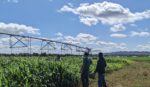
Using Less Water by "Stacking" Conservation Practices
There’s a reason so many of the climate-related projects funded by Western SARE focus on water. “In Utah and much of the West, water scarcity is the number one issue when it comes to the future of agriculture,” explained Matt Yost, an Agroclimate Extension Specialist at Utah State University. “The pressure on water systems is […]

Farmers Test Benefits of Using Hemp Stalks to Produce Mushrooms
When optimists are buried in proverbial lemons, they make lemonade. When the women who own Intentional Growth Farm in Utah had too many hemp stalks, they produced exceptionally large, tasty mushrooms. “We used the hemp stalks as the nutrient source for our oyster mushrooms, and customers said they were the best mushrooms they ever tasted,” […]
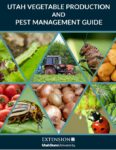
Utah Vegetable Production & Pest Management Guide
Partially funded by Western SARE, the Utah Vegetable Production and Pest Management Guide is inclusive to all growers, whether commercial or hobbyist. Although content is specific to Utah, most content applies to the Intermountain West states. The book includes twelve chapters of specific production methods and comprehensive pest and treatment recommendations for crops representing brassicas, […]
Temperature Management in High Tunnels
Understanding a crop's temperature requirements is the key to high tunnel management. This Utah State University fact sheet spells out temperature considerations and how these are best addressed using high tunnels and other season-extending technologies.
Specialty Crop Production in High Tunnels
A three-year, SARE-funded project focused on developing fruit and vegetable systems suited to high tunnel production in the high-elevation arid Intermountain West. Successful systems were developed for lettuce, tomato, squash and strawberry production. Work with brambles showed that methods suited to other regions were not locally appropriate. The following Utah State University Cooperative Extension fact […]

Adapting Cut Flower Production for Utah’s Climate and Soils
Sustainable Agriculture Fact Sheet July 2020 State: Utah Commodity: Cut Flowers Need: Science-based fertilizer and production recommendations for a new and growing industry Summary: Growing cut flowers as a high-value crop has recently become popular across Utah because of the crop’s unmatched profitability and small space requirements, yet minimal research and cultivation information […]
Responses to COVID-19 in Western Ag
Agriculture in the Western Region has been greatly impacted by COVID-19 and its resulting Shelter in Place orders, labor and processing challenges, and strongly shifting consumer behaviors and markets. It has also become clear that our agricultural community has been responding quickly and creatively. Western SARE cares about our community and feels a responsibility to share ideas and strategies. Toward that end, we conducted a survey of our state coordinators and project leaders of grants funded in the past three years. The data and examples are listed below. We will also create a report from this information, along with ideas provided on how Western SARE itself should adapt to the crisis.
Business Management Capacity for American Indian Agricultural Businesses
A curriculum on money and business management targeted for Native American participants.