Showing 1-20 of 22 results
Bridging Food Safety and Sustainability on California’s Central Coast
In this Sustainable Agriculture Action Plan funded project, the Community Environmental Council, the Central Coast Soil Hub, and the Coastal San Luis Conservation District brought together local farmers and food safety compliance consultants to discuss barriers in implementing sustainable practices while meeting food safety regulations. Fresh produce, one of the region’s primary economic drivers, is […]

Light it Up! Using UV Light to Kill Powdery Mildew in Grapes
Instead of relying solely on fungicides to control powdery mildew on winegrapes, growers may one day – and one day reasonably soon – have an effective non-chemical option: light. Specifically, light in the form of spore-killing ultraviolet UV-C radiation, delivered directly to the plant by a self-driving tractor moving through vineyard rows autonomously at night. […]

Breaking the Barriers to IPM Adoption in Wenatchee Pears
For all the promise, potential and profound benefits integrated pest management can bring, there’s also this harsh reality: IPM only works if people practice it. In some pear-growing regions in the Pacific Northwest, IPM is a widely accepted, effective and economical way to manage pear psylla and codling moth, the crop’s key insect pests. But […]

Boosting Beneficial Insects in Oregon’s Cherry Orchards
Eighty percent of Oregon’s cherries are produced in the Mid-Columbia Basin. Typically, when new orchards are planted, farmers leave the ground under the trees bare or plant grass. Farmers also regularly apply chemicals to control insect pests such as spotted wing drosophila, thrips, and leafhoppers, among others. However, planting mixed cover crops that include flowering […]
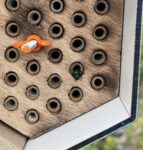
Can Introducing Mason Bees Boost Berry Pollination?
When it comes to berry pollination throughout the West, honeybees are the biggest show in town. That can be a problem for pollination diversity and for farmers because honeybees aren’t always the best option for some crops. “That’s especially true with blueberries,” said Miranda Jones, a graduate student in biology at Utah State University. “Blueberries […]
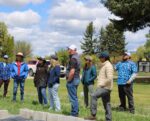
Exploring Montana Agriculture
The SARE Fellows trip to Montana was amazing. I enjoyed seeing the collaborative efforts among the various farms and organizations to share their knowledge, expertise, and resources to help each other thrive while meeting the needs of the community. This experience has shown me how people working together is what truly makes programs sustainable. – […]
CAB Collective Sustainable Agriculture Action Plan
The Sustainable Agriculture Action Plan for Cabernet Sauvignon and red Bordeaux (CAB) Wine Production in Paso Robles is a document developed by the Paso Robles CAB Collective winegrape growers, winemakers, marketers, proprietors, and other wine industry stakeholders for under a pilot grant program by Western SARE.
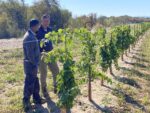
Reasons to Like Wine
Reasons to like wine Number 462: It can be good for New Mexico’s native bees and other pollinators. Even though grapevines are largely self pollinating and don’t need insects like bees or butterflies to produce fruit, vineyards themselves can provide habitat for native pollinators and other insect species, benefiting both the grower and the environment. […]
Video: Testing Cover Crops in New Mexico Vineyards
Watch our newest video describing this Western SARE funded work - Miranda Kersten, IPM Program and Gill Giese, Viticulture of New Mexico State University describe their work promoting putting cover crops in vineyards. The research will demonstrate how to ensure the cover crops successfully grow and flower so that they attract pollinators and provide additional […]
Specialty Crop Production in High Tunnels
A three-year, SARE-funded project focused on developing fruit and vegetable systems suited to high tunnel production in the high-elevation arid Intermountain West. Successful systems were developed for lettuce, tomato, squash and strawberry production. Work with brambles showed that methods suited to other regions were not locally appropriate. The following Utah State University Cooperative Extension fact […]
Large Raspberry Aphid
Large raspberry aphid is notable as a vector of viruses in Rubus, including Raspberry leaf mottle virus (RLMV, semi-persistent) and Raspberry latent virus (RpLV, persistent) in red raspberry, and Black raspberry necrosis virus (BRNV, non-persistent) in black raspberry. These viruses are to blame for decreased cane vigor and field decline requiring frequent replanting, as well […]
Integrating Small Goat Herd Production with Fruits and Vegetable Production
Most small family farms produce and market more than a single crop from their farm. Growing multiple crops promotes benefits coming from both biologic and economic diversification. This report resulted from a project in Hawaii with the purpose to develop a diversified production system by integrating the farm’s goat production enterprise into a crop production […]
Good Agricultural Practices Program for New Mexico
The goal of the Good Agricultural Practices (GAPs) Program for New Mexico is to provide educational materials to food producers and educational professionals associated with agriculture in order to reduce microbial risks in fruits and vegetables. The project's website includes examples of on-farm forms and signs, workshop/training information, and background information and resources on GAPs.
On-Farm Internship Training Binder
The Placer Ag Futures Project was conceived as a response to critical issues affecting local agricultural sustainability. This project was intended to help grow a new crop of agricultural professionals that are trained in sustainable agricultural practices. One part of the Ag Futures Project was the on-farm internship training. The summer internship program consisted of […]
Growing Grapes in Hawaii
The basis for this project was to show that grapes could again become a viable crop for Hawaii growers at low elevations. This addition of a crop, in demand by chefs, could greatly contribute to small farm sustainability.The history and horticultural needs are outlined in this extension publication, as are basic marketing needs and nutritional information.
Pineapple Production in CMNI
Farmer Joe Borja showcases his increasing production of pineapple in the Marianas Islands.

Earwigs Found to be Beneficial in Apple Orchards
Sustainable Agriculture Fact Sheet April 2020 Crop: Apples Need: Discovering whether earwigs are pest, neutral or beneficial insects in apple orchards States: Washington Background: Woolly apple aphids are a serious pest in apple orchards and are difficult to control with current insecticides. However, beneficial insect predators can […]

Fresh Growth Podcast
Fresh Growth: Approaches to a More Sustainable Future from Western Ag Practitioners introduces you to farmers and ranchers from around the western United States who are finding innovative sustainable practices that enrich the natural resources we all care about. These successful multi-generational operations experiment with new ideas and are making it pay. Listen in as they tell their story and provide advice for young or beginning farmers.Western SARE, funded by USDA NIFA, provides grants and education to advance innovations in sustainable agriculture. Intro music credit: Organic Energy by Kensington Studios used under license from Shutterstock. Learn more about Western SARE at western.sare.org
Improving Breadfruit Production in Hawai‘i
Sustainable Agriculture Fact Sheet June 2020 Background: Breadfruit has an array of potential ecological, social and economic benefits for Hawai‘i. Hawai‘i’s long history with breadfruit is founded on a body of unique local knowledge, where most cultivation has traditionally taken place in diversified agroforestry settings. The Problem: Breadfruit production is changing in Hawai‘i, […]
Using Beneficial Insects to Combat Pests and Engage Growers
Sustainable Agriculture Fact Sheet July 2020 State: California Commodity: Wine grapes Need: An economical way to control leafroll virus, which is spread by vine mealybugs Summary: Leafroll virus is infecting California grapevines at an alarming rate due to an aggressive insect vector, the vine mealybug. Leafroll virus infections reduce crop yield and quality, decrease a […]