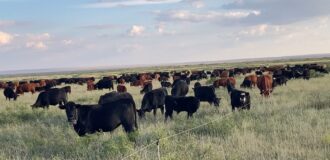
Ranchers across the West are increasingly turning to virtual fencing for its perceived benefits.
Virtual fencing allows cattle ranchers to manage the distribution of their livestock on rangelands without physical fencing. Just as physical fencing does, this emerging technology can contain cattle in one specific area, exclude them from certain areas, and more easily move them around the rangeland.
Virtual fencing works similarly to physical electronic fencing as cattle are trained to back away and stay in one area. An antenna on the ranch communicates with a computer. The rancher draws boundary lines on the computer. The cattle wear a collar which will give a small shock and make a light sound when getting too close to that line. This eliminates the need for physical fencing purchase costs, repairs, maintenance, and infrastructure.
Jorge Ramirez, Taiban Creek Ranch, noted improvements he and other ranchers saw in eastern New Mexico when confining herds to small areas. He says he learned about rotational grazing decades ago, and then intensive grazing using physical fences. This regenerative practice – putting cattle into a single herd in a small area for a brief period – can improve the land as they trample the soil and incorporate urea and manure into the soil. It prevents overgrazing of plants. Both soil quality and moisture holding capacity benefit.
“Virtual fencing is a tool. What you do with the tool is more important than the tool itself. Rotational grazing is important, and this tool makes it easier and more affordable,” says Ramirez.
Ramirez wanted Taiban Creek Ranch to be a demonstration of how virtual fencing can be used in a drought-stricken region to balance livelihood, animal welfare, and ecological resilience. He applied for a Farmer/Rancher grant and was awarded funding to do so.
“As the ecology recovers from continuous grazing, the grasslands will be able to produce more animal products per acre, at a lower cost. That will increase the incomes of the ranchers and include them in economic progress for their communities, regions, and several industries that grow alongside the ranching business.”
In the project, he and his team demonstrated virtual fencing for three years and compared existing management and animal condition records with the values after using virtual fencing. They used open source, satellite-based data focused on plant community and bare ground to document changes to healthy soil. Importantly, they shared results through on-ranch trainings, a webinar, and a podcast.
“Our ultimate educational goal was to engage enough neighboring producers to share land or leases by using this novel technology and thus build stronger ties among rural food system communities.”
He shares his successes with his neighbors. His land was severely degraded when he purchased it 10 years ago, but now it is in recovery. Meanwhile, neighboring lands are becoming more degraded using conventional grazing methods. Average stocking rates in the area are 12 cows per section, but he can go to 24-30.
“I have hopes that I will be able to run 4-5 times the stocking rate as my land improves.”
Ramirez is optimistic about the region’s future. “Ultimately, we want to transform regenerative agriculture into a more community-based experience, with knowledge sharing and support flowing among ranchers. From that groundwork, we can imagine multiple ranchers sharing a larger plot of land and being able to track and contain their herds precisely. Virtual fencing could change the way land is stewarded amongst different groups of people. Open-source technology can help us track and share that information.”