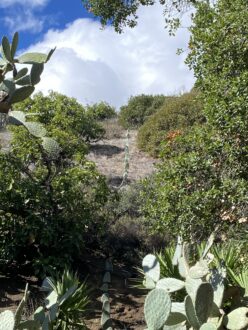
Liron Brish sees protecting farming in the United States as his life's mission. The tech innovator has launched several ag-focused ventures (including a new banking platform called Thombar for specialty crop growers) and he and his wife bought 10 acres in the hills above Santa Barbara, California to farm themselves.
There were just a few problems.
The avocado orchard on the property – and the irrigation pump and system that fed it – had burned in a wildfire in 2018. Brish could have repaired the system and replanted avocado as many of his neighbors did after the fire, but had reservations.
“We’re in California,” he explained. “Maybe it’s not such a good idea to reinvigorate a very water-intensive crop, no matter how much I love avocados. Water is only going to get more scarce and more expensive.”
Brish also learned after the fire that while the avocado trees burned, some plants didn’t.
“I started hearing, I’ll call them rural myths, about people who had a whole bunch of cactus or succulents or agave that protected their homes during the fire,” he said. “The fire didn’t burn through those areas.”
So he started looking for alternative crops that he, and perhaps others in similar dry, fire-prone environments, could grow profitably. With a Western SARE Farmer/Rancher grant he identified opuntia, or prickly pear, cactus as a candidate.
“Not only does it have sweet fruit, but researchers have been doing a lot of testing of it as a cattle feed or a biofuel to produce sustainable aviation fuel,” Brish said.
He consulted with John Cushman, a University of Nevada researcher to identify a variety that can stand up to the area’s roaring evening winds and met with the local fire department about where to plant the cactus to be an effective firebreak.
“They were very interested because they had heard the same rural myths about cactus,” he said. “They came and looked at the property and topography and said from a firebreak perspective, the ideal scenario would be to grow these on the ridge between my property and the Los Padres National Forest, so if a fire burns up to that ridge it doesn’t jump over.”
So last fall, Brish cleared more of the most flammable vegetation on his property and planted 600 linear feet of prickly pear cactus in a pattern he hopes will create an effective firebreak but also leaves paths for firefighters to weave their way through with shovels and hoses should the area ever be threatened with wildfire again.
If and how long it’ll take the cactus to grow into an effective firebreak – and a profitable crop – is an open question, but Brish thinks it’s one worth answering. Because the obvious alternative of simply replanting avocado doesn’t strike him as viable in the long term.
“We’re in a high fire danger area so as you can imagine it’s also a high-cost insurance area,” he said. “Having an avocado orchard and all that flammable material right next to your house doesn’t seem sustainable.”